Public Health · Municipal Cost · The Hidden Crisis
The Part of Homelessness Nobody Ever Talks About: Cleaning Up Human Feces.
Your city is already paying to clean it up. Every year. In every encampment where no one has a toilet. The bill shows up in sanitation, police overtime, hazmat contractors, and outbreak response — spread across enough departments that most cities can't tell you the total. Some have stopped trying. Here's what investigative reporters and city auditors have managed to surface. And our solution to this problem!
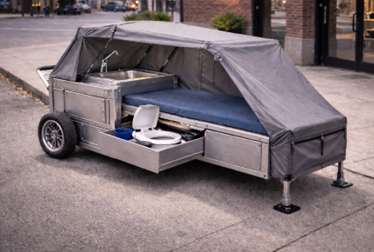
MCSU+H deployed · toilet drawer open · cassette toilet visible ·
city-emptied, not user-managed
The Cost · City by City
This is what cities are spending — just on cleanup. Not housing. Not outreach. Cleanup.
Most cities can't even tell you the total. The spending is buried across sanitation departments, parks departments, police overtime, transportation, and hazmat contractors — each keeping their own books. The numbers below are what investigative reporters and city auditors have managed to surface. The real number is always higher.
Los Angeles, CA
$31M+
Per year, sanitation workers alone. Plus $4.7M in police overtime to protect cleanup crews. Plus LADOT traffic control. Plus hazmat contractors. Nearly 15,000 cleanups in 2018. 714 tons of solid waste and 18.8 tons of hazardous waste removed from RV encampments in two years.
Seattle, WA
$20M
Annual Clean City budget. In 2025: 5.3 million pounds of waste removed from streets — the weight of 530 orca whales. 661,000 needles collected. Weekly trash service at 41 encampments. 19,419 purple bags distributed.
San Diego, CA
$10.5M
CleanSD homelessness budget. Five-day-a-week abatements. Contracts include $3.5M with Urban Corps, $2.2M with Clean Harbors. 66,000 encampment complaints in 2023. Officials explicitly link cleanup frequency to disease prevention.
Denver, CO
Unknown
A 2025 city audit found the mayor's administration was failing to track millions in spending on encampment cleanups. Daily coordination meetings not documented. Of 36 audit recommendations from 2023, only 6 fully implemented. "No one — not even his office — has a full picture of what Denver is spending."
Austin, TX
$2.1M+
Austin Resource Recovery alone spent $1.83M in FY2024 — not counting Parks ($311K), Police, or other departments. 1,720 tons of trash removed. A single 3-week cleanup blitz cost $830K. The city is still building a dashboard to track the real total.
San Francisco, CA
118,352
Reported instances of human fecal matter on city streets since 2011 — and that's only the ones called in. The city runs a dedicated "Poop Patrol." Santa Monica Pier repeatedly ranked among California's most polluted beaches due to human waste runoff.
Oceanside, CA
$4.2M
Spent over four years on one cleanup contractor alone. Nearly $1M more approved for next year. Cleanup spending exceeds what the city spends on housing navigation and outreach combined. Four nearby cities told reporters they don't track the spending at all.
Vancouver, WA
$1.46M
Since 2021: 240 encampment cleanups. This year alone: 16 large-scale cleanups collected 216,000 pounds of waste and cost nearly $81,000. The city nearly exhausted its $300K annual cap less than two years into a five-year cleanup contract.
Minneapolis, MN
$332,620
Cost of closing 17 encampments in just the second half of 2024 alone — 81% went to police costs, the rest to Public Works. City's own director estimates each closure runs $10,000–$20,000, and says keeping an encampment mitigated and "safe" while it stays open costs 10 times that.
Lexington, KY
$1,850avg
Average cost per encampment clearing. 28 clearings so far in FY2025 — call it roughly $52,000 for the year, in a city a fraction the size of LA or Seattle. The pattern holds at every scale.
Tulsa, OK
Unknown
City leaders admitted outright: "Historically, City of Tulsa staff has not had a strategic direction for encampment decommissioning." No budget. No tracking. Just now standing up a team to handle it — after years of ad hoc clearings.
More Cities, Same Story
Wheeling, WV$41,350
Baltimore, MD$60,000
Kansas City, MO$750,000
Albuquerque, NM$2.2M
Single-contract and single-year figures pulled from local reporting, budget documents, and audits. Every city has a number like this. What's yours?
Every Other City
$1,672–$6,208
Per unsheltered person per year in encampment response costs, according to a HUD/HHS study. Almost none of it comes from federal funds — HUD money cannot be used for cleaning, sanitation, or policing. Cities pay it themselves, out of general fund dollars.
$31,065 vs. $10,051
Annual cost to criminalize one person experiencing homelessness, vs. the annual cost of supportive housing for that same person
"People go out and clean it up, and then the next week, there it is again." — Austin resident near a homeless encampment
"We don't have a homeless problem. We have a problem
that we can see homeless people. And if we can make it
so we don't see so many of these people, we've solved
the problem. People get hurt."
— Paul Boden, Western Regional Advocacy Project
· NPR · January 2026
The pattern holds everywhere. The crew arrives. The encampment clears out around the corner. The crew leaves. The encampment returns. The ticket gets written up. The money gets spent. Nobody in city hall can tell you the total because it's spread across too many departments to add up — and because nobody wants to say the number out loud.
The Work Nobody Talks About
What it actually takes to clean a homeless encampment.
Before a city sanitation crew can start, the area has to be cleared by police. Then they suit up. Not in work clothes — in personal protective equipment: gloves, respirators, hazmat suits. The materials they're handling are classified as biohazardous. OSHA has been asked whether encampment cleanup falls under the HAZWOPER standard — the regulation that covers workers exposed to hazardous substances. The answer: it depends on what's there, and a lot of the time, it qualifies.
"Biohazard cleanup isn't for the faint of heart. It's needles in the dirt, shit in the grass, and trash that's more than meets the eye. A single misstep — like brushing a needle without the right gloves — could mean a trip to the ER." — T.A.C.T. Biohazard, D.C.
What workers actually encounter on a cleanup:
Human feces
Every city, every cleanup
Power-washed off sidewalks, scraped from building entrances, removed from stairwells and doorways. Carries hepatitis A, shigella, E. coli, norovirus, and more.
Used needles
661,000 collected in Seattle in 2025 alone
Each one a potential hepatitis B, hepatitis C, or HIV exposure. Require special sharps containers and disposal protocols. Cannot be handled without puncture-resistant gloves.
Urine-soaked materials
Bedding, clothing, cardboard
Fabric and porous materials classified as contaminated. In some jurisdictions must be removed for laundering or disposed of as biohazardous waste, not regular trash.
Bodily fluids
Blood, vomit, wound drainage
Bloodborne pathogen exposure risk. Workers required to follow OSHA Blood or Other Potentially Infectious Material (BOPIM) standards. Requires EPA-approved disinfectants.
Drug paraphernalia
Fentanyl residue, pipes, spoons
Synthetic opioids present on surfaces can cause exposure through skin contact. OSHA has identified these as potentially triggering HAZWOPER requirements at encampment sites.
Rat nesting material
Berkeley, Los Angeles, Chicago
Human waste attracts rats. Rat urine and nesting material carry leptospirosis. In Berkeley in 2026, cleanup of a single encampment required 30+ days to fully eradicate the infestation.
After the hazmat work, comes the powerwash. Then the crew packs up and goes home — to their families, their kids, their dinner tables. And within hours, sometimes within minutes, the encampment begins to re-form. Because nothing that drove it there has changed.
Minutes.
Time before an encampment begins to return after a cleanup crew leaves — Los Angeles, documented repeatedly
The Outbreaks · Documented, Named, and Preventable
These weren't natural disasters. They were toilet problems.
Every outbreak below has a paper trail. Every one was linked by public health officials — in their own reports — to the absence of sanitation access. Every one cost cities emergency response money on top of their regular cleanup budgets. And every one was described, after the fact, as preventable.
Hepatitis A
San Diego · 2017
20 dead. 948 infected. The city's own report identified the shortage of public restrooms as a leading cause. Officials later found better sanitation measures could have slowed the spread. San Diego had 16 mobile toilet stations for 36,000 homeless people — and removed them at night.
Typhus
Los Angeles · 2018–2019
A medieval disease spread by infected fleas on rats drawn to human waste. 167 cases confirmed. Part of LA City Hall briefly closed after rodent infestation. A city staffer contracted it at work. Governor Newsom: "Typhus. A medieval disease. In California. In 2019."
Shigellosis
San Diego · 2021 · Washington State
53 people infected in San Diego, all homeless. Shigella spreads through feces. Also documented in Washington state encampments. Causes severe diarrheal disease; can be life-threatening without treatment.
Trench Fever
Washington State · Seattle
Spread through body lice. Historically a WWI battlefield disease — now documented in West Coast encampments. The conditions that produce it: no sanitation, no showers, no way to stay clean.
Leptospirosis
Berkeley · 2026
Deadly bacterial infection spread through rat urine. Confirmed in multiple rats and dogs at a Harrison Street encampment. Can cause kidney damage, meningitis, liver failure, and death. Cleanup required 30+ days. The city was barred by federal injunction from clearing the encampment to stop the spread.
Hepatitis A
Los Angeles · 2012
County health officials cited the city for health code violations and filthy conditions that contributed to an outbreak. The city responded with Operation Healthy Streets. Since then, the homeless population increased 47 percent — and the program never kept pace.
"Our homeless crisis is increasingly becoming a public health crisis." — California Governor Gavin Newsom, State of the State, 2019, citing hepatitis A, syphilis, and typhus outbreaks simultaneously
The diseases don't stay in the encampments. UCLA's Dr. Jeffrey Klausner explained it simply: feces and urine on LA sidewalks end up on residents' shoes. Those residents track it into homes and offices. They touch their shoes, touch their eyes, touch their mouths. "We can get gastroenteritis, norovirus," he said. "Everyone's at risk at some level."
San Diego's deputy director of Environmental Services put it even more plainly: "We know if we don't go there… you're in feces, needles, all that for days. That's when you start getting the transmission of diseases."
The Question That Ends the Argument
Who else has a toilet that travels with them?
Think about the populations that spend significant time away from fixed bathroom infrastructure. Every one of them — without exception — gets a toilet that goes with them. It is considered basic dignity. In most cases it is a legal or regulatory requirement.
RV OwnersCassette toilet, black water tank, full sanitation system built into the vehicle. The MCSU+H toilet hardware — the Thetford C260 series — is the same technology.
Long-Haul TruckersPortable toilet in the cab. Federal hours-of-service rules make frequent stops impractical. The toilet travels with the job.
Offshore Oil WorkersSanitation infrastructure travels with the platform. No fixed address. No fixed restroom. The platform carries what the workers need.
Military Field UnitsPortable latrine systems deploy with every unit in the field. Sanitation is a tactical and health requirement, not an afterthought.
Sailors and BoatersMarine heads, holding tanks, pump-out stations. Living on a vessel without sanitation is illegal in most US waters.
AstronautsThe most engineered version of this problem ever solved. Zero gravity. Complete sanitation. Because the alternative is unthinkable.
Construction WorkersOSHA requires portable toilets at every job site. One toilet per 20 workers. Required by federal law.
Unsheltered HomelessThe one population that moves constantly, has no fixed infrastructure, and is legally swept from place to place. Gets nothing. Goes on the sidewalk. The city sends someone in a hazmat suit.
Truckers have one. RV owners have one. Soldiers in the field have one. Construction workers are legally required to have one. The person sleeping on your city's sidewalk doesn't — and your city is spending millions every year cleaning up the result.
The Math Nobody Has Done
Your city is already paying for the alternative. The alternative is feces on the street.
Los Angeles spent $31 million on sanitation workers alone in a single year — not counting police overtime, hazmat contractors, disease outbreak response, or the cost of the hepatitis A emergency. San Diego's 2017 hepatitis A outbreak response cost millions on top of the regular budget. Seattle spent $20 million removing 5.3 million pounds of waste that came back the following week.
None of that money moved anyone into housing. None of it prevented a single outbreak. None of it kept a single encampment from returning. It paid people to clean up the consequence of a decision — that unsheltered people would have no toilet — over and over again, indefinitely, at scale.
$0
What a cassette toilet service call costs when it folds into a sanitation route the city already runs
The MCSU+H includes a built-in cassette toilet — the same technology used in RVs, boats, and portable sanitation systems worldwide. The city empties it. The city already has sanitation crews running routes. The cassette swap folds into a route that already exists. No new contract. No new crew. No hazmat. No outbreak response. No powerwashing.
Your city is already paying to clean it up. This stops it from happening.
A toilet that moves with the person
It doesn't solve homelessness. It stops the part that's making people sick and costing your city millions.
The MCSU+H (Mobile Cart Support Unit + Hygiene) is a patent-pending, city-owned deployable shelter unit with a built-in bed, sink, and cassette toilet. City-owned and GPS-tracked — like any other piece of municipal equipment. The city tracks the equipment, not the person. Prototype complete end of July 2026. Demos begin August.