For City Officials · State Housing Directors · Legislative Staffers
Your State Is Taking Action On Encampments.
Almost None Of It Comes With Funding — Or Equipment.
22 states have passed, or are actively considering, laws responding to homeless encampments — from enforcement bans to optional designated-site provisions. 19 of the 22 attach zero state funding. None define what equipment a compliant shelter site actually needs. Until now.
22
States tracked for encampment-related law or active bills
Cities that submit a Letter of Interest receive priority placement — an in-person, on-site demo of the working unit, in your office, before public scheduling opens. Prototype completes end of July 2026. Demos begin August.
Reserve a demo through a Letter of Interest. Simply email us your Letter of Interest.
The Housing First system isn't broken. The MCSU+H is the bridge — for the people the waitlist hasn't reached yet.
Closed
Ready to move
Open
Shelter active
Toilet
City empties it
Dignity
In place
The Response Is Uneven. The Equipment Gap Isn't.
Some States Mandated It. Some Just Banned It. None Defined It.
The 22 states on this page don't follow one pattern — some passed hard requirements, some just banned camping and stopped there, some bills died before a vote, and a few never became law at all. But across every version of this — enacted, pending, or enforcement-only — no state has defined what a compliant shelter looks like, and almost none put money behind it.
What No State Has Defined:
No equipment standard — no definition of what a compliant shelter actually looks like, in any of the 22
No funding appropriation in the vast majority of states — and where funding does exist (Utah, California), it's tied to enforcement compliance, not equipment
No operational model for the equipment itself — even states with the most detailed standards (Florida, NC, Louisiana) define outcomes like sanitation and security, not what physical unit satisfies them
No equipment vendor — nothing on the market built specifically for this purpose
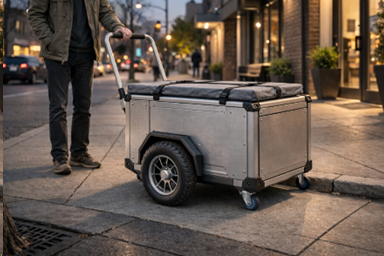
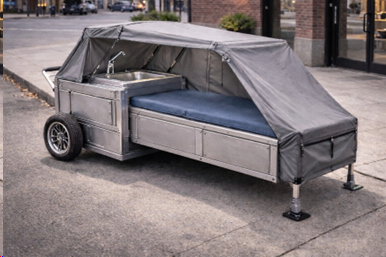
What A Purpose-Built Unit Looks Like.
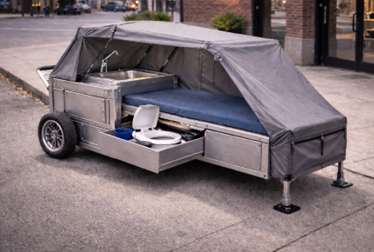
Restrooms — built-in cassette toilet, canister swapped every 3 days on existing sanitation truck route
Running water — built-in sink, foot pump, 1–2 gallon fresh and gray tanks
Safety and security — locked weather-proof enclosure, city-assigned unit, private shelter
Shelter alternative — deployable twin-size bed, weather-proof canopy, fully enclosed
Fixed outreach location — same person, same unit, same location every week
No land, no permit, no hookups — folds to cart size, deploys in under 2 minutes, goes anywhere
One-time capital purchase — no HUD strings, no new yearly contract, fits within existing budget authority
Some states set physical standards. Some just banned camping. Some bills never passed. Here's exactly where each one stands — and where the MCSU+H fits regardless of which category it's in.
Passed — Sent to Governor July 2026
North Carolina
H437
What the state mandated — no funding attached
Ensure safety and security of designated property and persons
Maintain sanitation — at minimum, clean and operable restrooms and running water
Coordinate with county health department to provide behavioral health services
Prohibit illegal substance and alcohol use on designated property
Only applies IF a city chooses to designate a site — cities may simply ban camping outright with no designated site at all
MCSU+H satisfies every requirement — if or when a city designates
Built-in cassette toilet — swapped every 3 days on existing sanitation route ✓ restrooms
Built-in sink with foot pump and fresh/gray tanks ✓ running water
Locked weather-proof enclosure, city-assigned unit ✓ safety and security
For cities that skip designation entirely, MCSU+H is still a lower-cost way to offer a documented alternative before enforcement
Active — Effective July 1, 2026
Indiana
SB 285 — Signed March 2026
What the state mandated — no funding attached
Law enforcement must assess for mental health emergency detention before enforcement
Must provide warning and information about available shelter or services
48-hour grace period before criminal charge — person cannot be charged if no shelter within 5 miles
Cities may encourage diversion programs or provide housing and shelter in lieu of citation
MCSU+H satisfies every requirement
Provides a documented shelter alternative — satisfies the "shelter available" requirement
City-assigned unit = documented offer of alternative ✓ diversion program
Fixed location enables consistent mental health outreach access
Removes the legal exposure of "no shelter within 5 miles"
Active — Signed June 2026
Louisiana
HB 211 — Act No. 788
What the state mandated — no funding attached
Local governments may designate camping areas if shelter is insufficient
Designated areas must provide access to restrooms, running water, and behavioral health services
Property cannot be adjacent to residential areas or negatively affect property values
Department of Health may inspect designated property at any time
MCSU+H satisfies every requirement — if or when a locality designates
Built-in cassette toilet ✓ restroom requirement
Built-in sink with foot pump ✓ running water requirement
No fixed site — goes where person goes, no zoning restrictions on placement
Documented city-owned asset — ready for Health Dept inspection at any time
Active — Effective October 2024
Florida
HB 1365 — Signed March 2024
What the state mandated — no funding attached
Ensure safety and security of designated property and persons
Maintain sanitation — at minimum, clean and operable restrooms and running water
Coordinate with regional managing entity (DCF) to provide behavioral health services
Standards must be published on county/municipal website within 30 days
DCF may inspect designated property at any time
Designation is optional for counties — these standards only apply if a county chooses to designate
MCSU+H satisfies every requirement — if or when a county designates
Built-in sink with fresh/gray tanks ✓ running water requirement
Locked enclosure, city-assigned unit ✓ safety and security
City-owned asset — publishable standard, ready for DCF inspection whenever a county opts in
Active — Signed 2026
Georgia
HB 295 — Safe Neighborhoods Act
What the state mandated — no funding attached
Allows property owners to sue or seek compensation when cities fail to enforce existing camping/nuisance bans
Creates no site-designation mechanism and no shelter-standard requirement whatsoever
Pure enforcement-liability model, modeled on Arizona's Prop 312
MCSU+H reduces the exposure HB 295 creates
HB 295 doesn't require a shelter alternative — it only exposes cities to lawsuits for non-enforcement
A documented, city-owned unit gives a city something concrete to point to as active response, without a new operating contract
Lowers the practical need to choose between costly sweeps and doing nothing
Active — Effective July 2022
Tennessee
HB 978 — Equal Access to Public Property Act
What the state mandated — no funding attached
Camping on public property is a Class A misdemeanor (first offense), Class E felony (repeat)
TDOT directed to develop encampment clearing plans with local stakeholders
Local nonprofits must be included in clearance process planning
No state funding for alternative shelter or equipment
MCSU+H gives officers and TDOT a real alternative to offer
Tennessee's law sets no shelter or equipment standard — it just criminalizes camping
Gives TDOT and local stakeholders a concrete alternative to offer during clearance planning
City-owned unit — a documented offer before felony enforcement, without any state requirement to provide one
Nonprofits can reference MCSU+H in clearance planning as the humane off-ramp
Active — Effective 2021
Texas
HB 1925 — Statewide Camping Ban
What the state mandated — no funding attached
Bans public camping statewide — cities cannot be more permissive than state law
Cities must enforce camping bans or face state intervention
Fines up to $500 for public camping — citation-based, not arrest
No alternative shelter requirement, no funding for alternatives
MCSU+H gives cities something to point to, though Texas requires nothing
Texas sets no shelter requirement — a city can enforce the ban with nothing to offer at all
A documented alternative before citation reduces enforcement friction without any state requirement to provide one
Gives Texas cities something concrete when constituents ask "what's next?"
No HUD strings — procurable outside CoC funding entirely
Active — Executive Order July 2024
California
Executive Order N-1-24 (2024)
What the state mandated — real funding attached
48-hour notice required before clearing any encampment
Outreach to local service providers required
Proper storage of belongings for at least 60 days
Must offer shelter or services before removal where available
Cities that don't comply risk losing state funding — backed by billions in state grants ($24B overall, $3.2B in encampment-specific grants, $131M in encampment-clearing grants, $3.3B in Prop 1 funds)
MCSU+H satisfies every requirement
Provides documented shelter offer prior to 48-hour notice ✓
Unit assignment = service connection — satisfies outreach requirement
Locked storage inside unit — no need for 60-day storage facilities
Visible, fundable action — protects state funding eligibility
Active — Effective 2023
Missouri
H.B. 1606 (2022) — Mo. Rev. Stat. §67.2300
What the state mandated — funding redirected, not added
Bans unauthorized camping on state-owned land; camp facilities are optional for localities
Redirects existing Housing Trust Fund dollars toward optional camp facilities — not new appropriated funding
No alternative shelter requirement — just enforce the ban
MCSU+H is eligible for the redirected funding Missouri already created
Missouri sets no shelter requirement — camp facilities are optional, funded from existing redirected dollars if a locality opts in
City-owned asset demonstrates active compliance without just sweeping
Procurable as sanitation or public safety equipment — outside housing budget
Active — HB 499 + County Mandates
Utah
HB 499 — Shelter and Camping Enforcement
What the state mandated — real funding attached, tied to enforcement
Counties with 175,000+ population must create winter unsheltered plans
Cities with camping bans must enforce them to receive mitigation funding
"Code Blue" protocol — resource centers must expand capacity 35% at extreme cold
Cities must enforce or lose Homeless Shelter Cities Mitigation Fund payments
MCSU+H satisfies every requirement
Weather-proof enclosure addresses cold-weather Code Blue scenarios
Documented shelter assignment satisfies winter plan requirement
City-owned units = demonstrated compliance → protects mitigation funding
Deployable in days — responds faster than any brick-and-mortar expansion
Active — Effective November 2024
Oklahoma
SB 1854 — Anti-Camping Law
What the state mandated — no funding attached
Bans unauthorized camping on state-owned land only (not city/county land)
First-time violators must get a warning and an offer of shelter/food-pantry transport before citation
No site-designation requirement, no funding attached to the law itself
MCSU+H gives officers something to offer at the point of contact
SB 1854 requires a warning and an offer of shelter/services before citation — a city-assigned unit is a concrete offer to make
Reduces the odds of citation by giving officers a real alternative to point to, not just a shelter list
City-owned asset — no funding or designation required by the law itself to deploy it
Active — Effective 2025
Arizona
Proposition 312 — Property Tax Refund Law
What the state mandated — no funding attached
Lets property owners claim a property-tax refund for costs incurred when a city has a pattern of not enforcing existing camping/nuisance laws
Not a camping ban itself — no site-designation mechanism, no shelter standard
Reduces city revenue rather than adding funding
MCSU+H reduces a city's Prop 312 exposure
Prop 312 penalizes cities for a pattern of non-enforcement — a documented, active response supports a city's enforcement record
No fixed site — deploys in any zone without a permit or new ordinance
One-time purchase, not a new tax-funded program — doesn't add to the revenue pressure Prop 312 already creates
Failed — Died on Senate Calendar, 2024
Kansas
SB 542 — Did Not Pass
What the state is moving — no funding proposed
Cicero Institute model bill introduced — statewide camping ban
Cities would be required to enforce or face state action
No alternative shelter requirement in the bill
MCSU+H positions cities ahead of the bill
Get ahead of the mandate — deploy before enforcement is required
Documented alternative on the ground when the bill passes
No HUD strings — procurable now without waiting for state guidance
No Statewide Law — NYC Local Policy Only
New York
No Enacted State Law
What exists today — no equipment funding, no statewide mandate
No statewide encampment or camping-ban law exists
NYC's aggressive sweeps and involuntary-commitment expansion are city/local policy, not a state mandate
A 2025 "fair share for homeless shelters" bill (A7585) is still pending committee, not enacted
MCSU+H is ready if or when New York passes a statewide standard
No statewide requirement exists yet — but NYC's own sweep data (3 of 2,308 people housed, per the Comptroller) shows what happens without a documented alternative
Provides a stable location for outreach in the meantime — replaces "lost contact" case outcomes
Keeps people in the navigation pipeline instead of resetting to zero after each sweep
Active — Local Enforcement
Colorado
Denver Encampment Ordinances + Statewide Pressure
What cities are required to do — no state funding
Denver cleared largest encampment in 2025 under city ordinance
Sanctioned camp estimate: $24,000 per camper per year (Boulder)
Cities responsible for alternatives — no state equipment standard
MCSU+H fills the equipment gap no state standard defines
Fraction of $24,000/year sanctioned camp cost — one-time capital purchase
No land, no fence, no permit — deploys on existing city surfaces
Gives Denver and Boulder a visible, fundable answer to constituent pressure, without waiting on a state equipment standard that doesn't exist
Active — 150+ City Ordinances
Illinois
150+ Local Camping Bans Post-Grants Pass
What cities are required to do — no state funding
150+ Illinois cities have passed or expanded camping bans since Grants Pass
Chicago conducting active sweeps — Humboldt Park encampment cleared Dec 2024
Each city responsible for its own compliance — no state equipment standard
MCSU+H fills the equipment gap no city ordinance defines
Scalable across 150+ cities — same unit, same service model, any location
No city-specific permitting — deploys on existing surfaces
One-time capital purchase fits within local budget authority, without waiting on a state equipment standard that doesn't exist
Active — Local Enforcement
Nevada
Las Vegas + Statewide Camping Bans
What cities are required to do — no state funding
Las Vegas: fines up to $1,000 or six months jail for camping ban violations
Multiple cities with active enforcement post-Grants Pass
No state alternative shelter requirement or equipment standard
MCSU+H gives cities a visible answer, though Nevada requires nothing
Nevada sets no shelter or equipment standard — a documented alternative before a $1,000 fine or jail is a choice, not a requirement
City-owned unit — visible answer to constituent pressure on the Strip and beyond
Deployable before next enforcement action — no lead time required
Existing Law Still In Effect
Oregon
ORS 195.530 (2021)
What state law actually does — no state funding
Existing state law actually limits cities' ability to enforce camping bans unless policies are "objectively reasonable"
2025 efforts to roll this back failed — Democratic leadership declined to take it up
No site-designation mandate exists in Oregon law at all
Portland: 19 encampments cleared per day, ~5,000 per year, under existing local authority — same people come back
MCSU+H offers a way out of the sweep cycle Oregon law doesn't resolve
Oregon sets no equipment standard in either direction — this addresses the underlying sweep-and-return cycle regardless of how the enforcement/protection debate resolves
Fraction of $34,000/year sanctioned camp — one-time purchase, no yearly contract
Keeps people in the system instead of resetting their case every time a sweep happens
Contested — Both Directions
Washington
HB 2489 Died — Cities Sweeping Anyway
What cities are doing — no funded alternative
HB 2489 (protection bill) died in committee Feb 2026 — cities free to sweep
Seattle: $200M/year homeless response — active encampment removals continuing
Neither side of the debate proposed funded equipment alternatives
MCSU+H works regardless of which direction the bill goes
If sweeps continue — provides documented alternative before enforcement
If protections pass — demonstrates city is already doing something humane
Policy-neutral: works under any legislative outcome
Enacted But Inert — Effective Date 2050
Hawaii
SB471 (2024) — Safe Zones Law
What the law actually says — appropriation included, but dormant
Actually requires the state or counties to establish "safe zones" for homeless persons — a real designation mandate, unlike every other state on this page
Includes an appropriation clause for a drop-off center (dollar amount left blank — "as necessary")
Critical catch: the operative section's effective date is set to December 31, 2050 — it currently has no practical legal force
MCSU+H is ready for whenever the mandate actually takes effect
Hawaii already has a legal safe-zone requirement on the books — it just doesn't take effect until 2050, or sooner if lawmakers move the date up
A county that wants to act now, ahead of that date, gets a low-cost way to stand up a compliant safe zone without waiting on state guidance
City-owned asset — no operator contract, no yearly cost, ready whenever the state decides to enforce it
Failed — Died in Senate Subcommittee, March 2025
Iowa
SSB 1195 / HSB 286 — Did Not Advance
What the bill would have mandated — no funding proposed
Would have created statewide penalties for camping, while allowing (not requiring) local governments to create designated areas
Approved by a House subcommittee but failed to advance in the Senate — not law
No alternative shelter requirement in the bill
MCSU+H positions cities ahead of the bill
Get ahead of the mandate — cities can act now without waiting for the bill
One-time capital purchase outside HUD CoC — no federal strings
Deployable immediately when the law takes effect
Pending — Introduced November 2025
Wisconsin
SB 621 — Structured Camping Facilities
What the bill would mandate — no funding proposed
Would let the state or localities designate "structured camping facilities" — optional, not required, in most cases
Exception: if a waiting list in one area hits 12+ people, the state can force a designation without local approval
Still pending in committee — not enacted
MCSU+H positions cities ahead of the bill
Documented action before the bill passes — strongest political position
City-owned capital asset — shows fiscal responsibility in audit
Deployable without state guidance — no waiting required
Open — Shelter Active73″ · Canopy · Bed · Sink · Under 2 min
Toilet DrawerCassette · City empties it · Full 34″ width
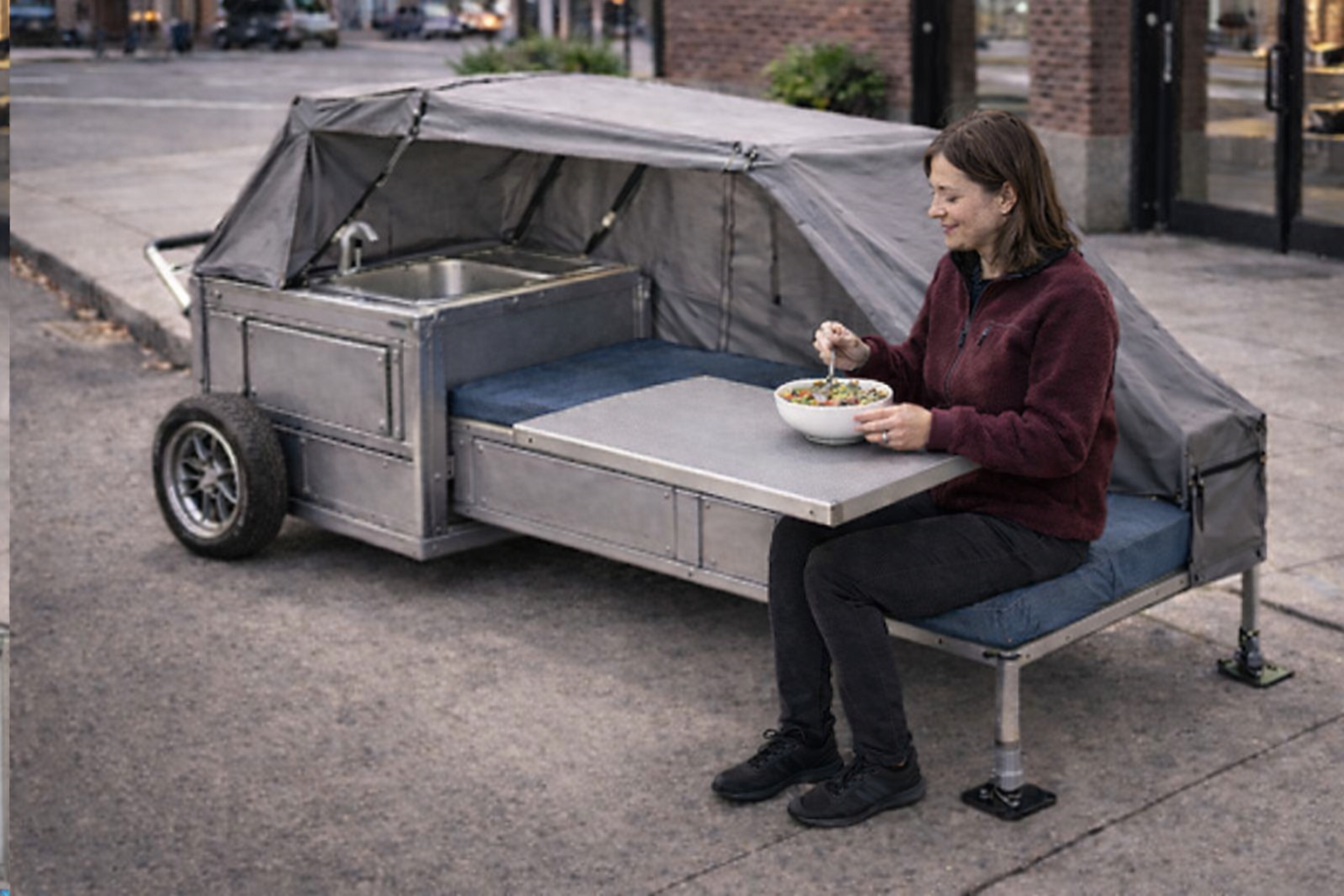
Dignity In PlaceFold-down table · A place to sit · A place to eat
Bed
73″ deployed · nearly twin length
Toilet
Cassette · swapped every 3 days · existing sanitation route
Sink
Foot pump · 1–2 gal fresh + gray tanks · running water
Lock
ID · meds · documents · papers secured
Canopy
Weather-proof snap enclosure · private shelter
< 2 min
Deploy time · one person · no tools
Patent Pending No. 63/987,871 · Mitchell-Lambdin Foundation LLC · No site. No permit. No crew. No truck. No new yearly contract.
Whatever Your State Requires. We Have The Bridge.
Prototype completes end of July 2026. Demos begin August. Cities that reserve now go first on the schedule. No commitment, no LOI required — just twenty minutes with the working unit.
In-office or video · No commitment required · Demos begin August 2026
"Some states passed hard mandates. Some just banned camping and stopped there. Either way, cities are the ones left figuring out what to actually put on the ground — with their own budgets and no equipment standard to work from. The MCSU+H is a one-time capital purchase that fits within existing budget authority. No council vote required for a pilot. No HUD strings. No new yearly contract."