For Council Members · Mayors · City Managers · Budget Officers

The Same People Are Back In Three Days. And A Single Sweep Can Cost Your City As Much As $50,000.

Encampment clearances run from $8,000 to $50,000 each in labor, equipment, and disposal — and move no one into housing. There is now a documented alternative that costs less than one sweep, requires no site, no operator, and no annual budget commitment.

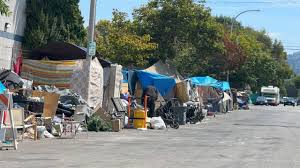
Homeless encampment on city street

Here’s what your constituents see on the way to work, home, grocery store, church, shopping, the movies… every time they leave the house. No wonder they ask what is the city doing about this.

There is now an alternative.
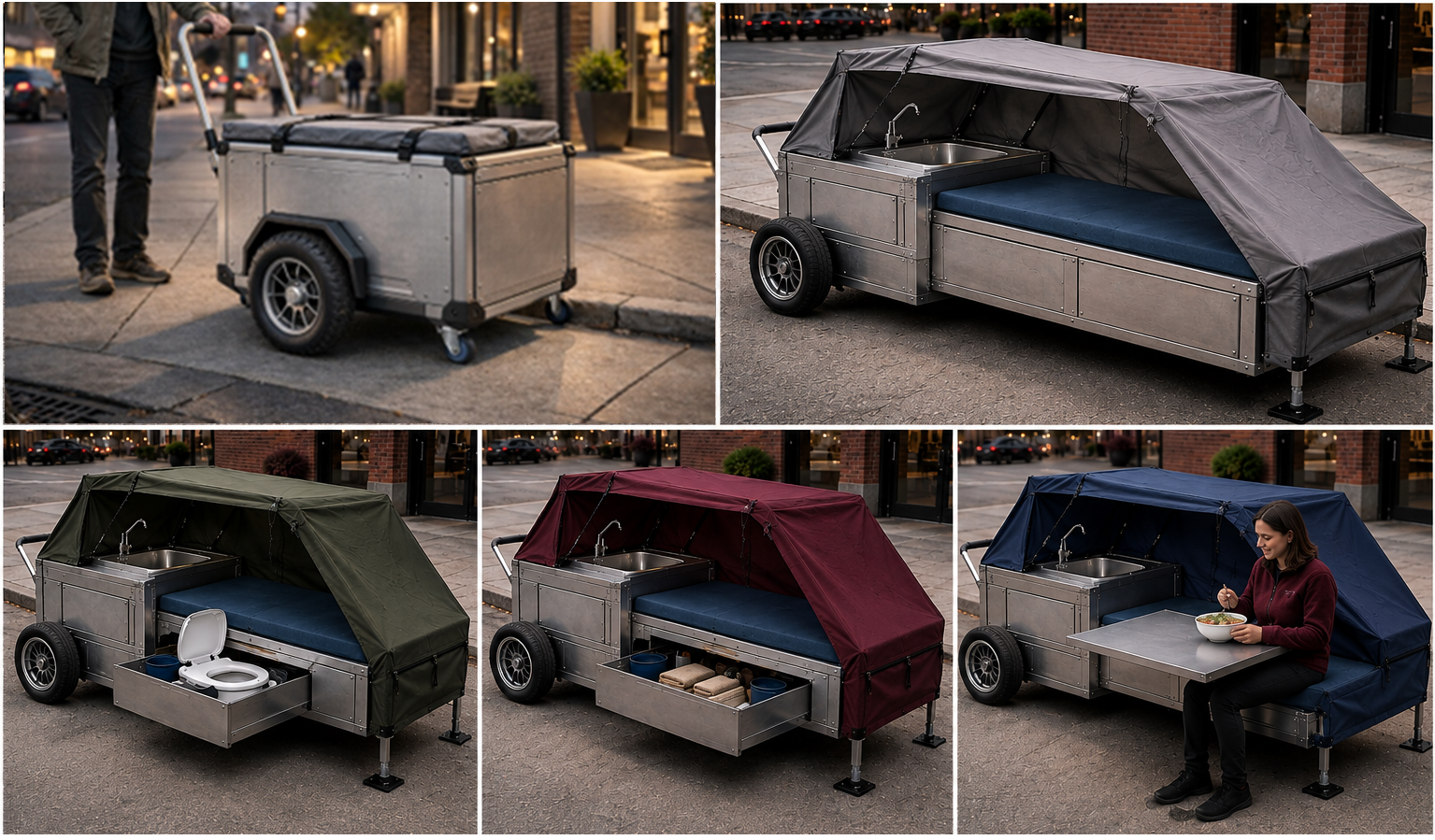
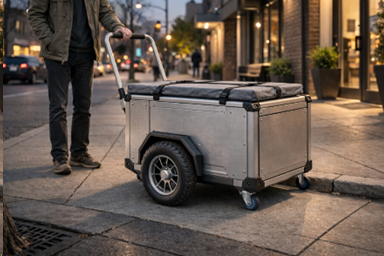
MCSU+H Closed — Transport Ready
Closed — Transport Ready
42″ × 34″ × 30″
Costco cart footprint · Any sidewalk
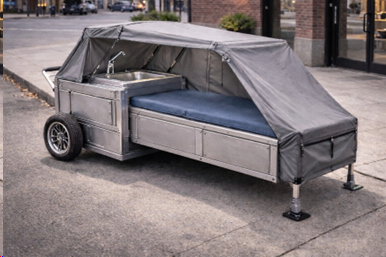
MCSU+H Deployed
Deployed — Shelter Active
73″ total · Canopy · Bed · Sink
One person · Under 2 minutes
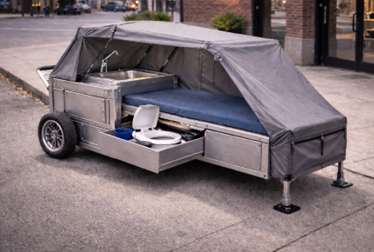
MCSU+H Sanitation Drawer Open
Sanitation Drawer Open
Cassette toilet · Full 34″ width
Locked storage · Patent Pending
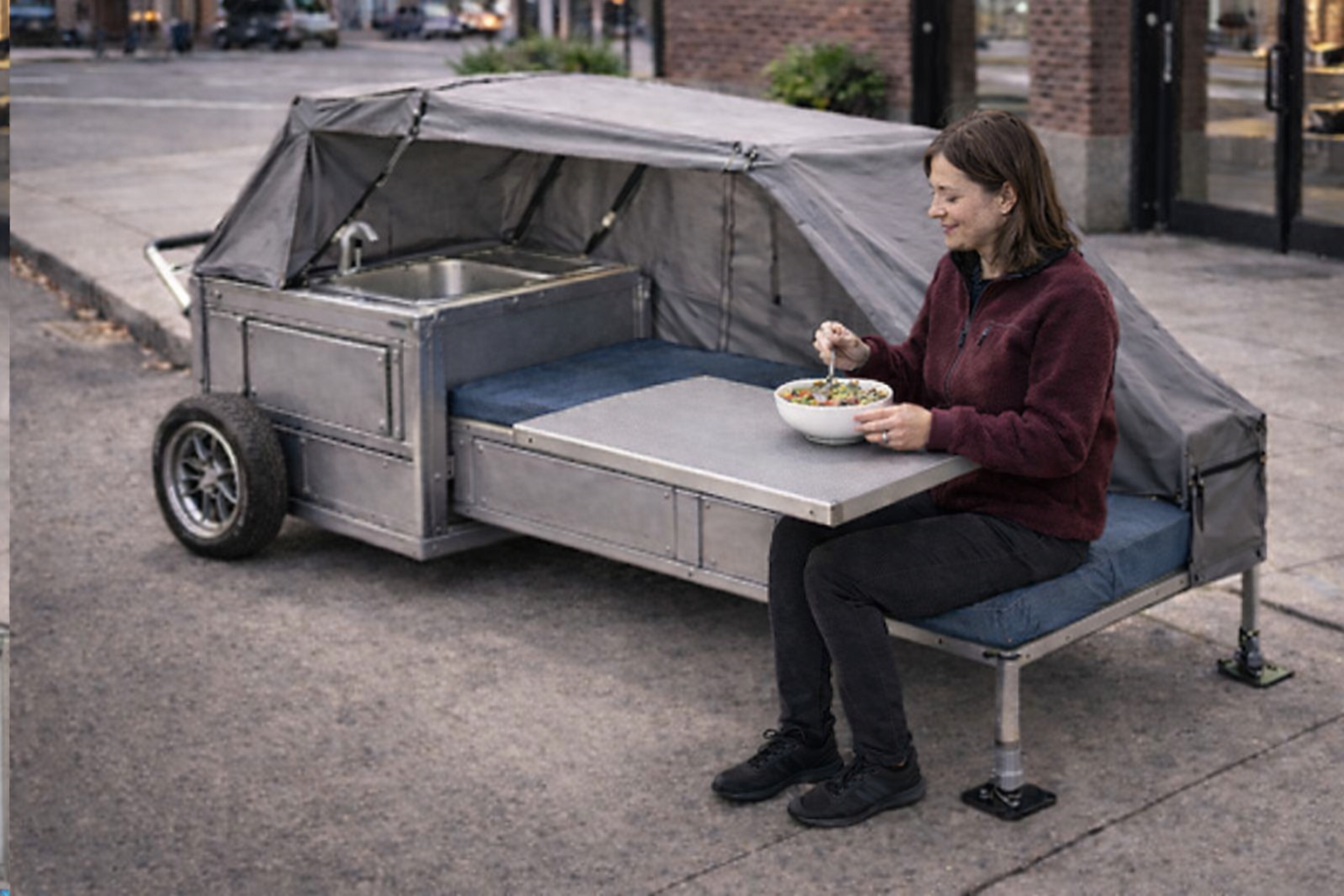
Woman eating at table in MCSU+H unit
Dignity In Place
Interior table · Fold-down surface
A place to sit · A place to eat
Grants Pass v. Johnson — U.S. Supreme Court, 2024

It Gave Cities The Green Light.
It Didn’t Give Them A Solution.

So the Homeless Shuffle™ continues —
same people, same streets, three days later.

Cities call it enforcement. Advocates call it displacement. Everyday citizens just watch the same unsheltered people come back.

The Homeless Shuffle™

Of 3,300 housing authorities in America,
most are not accepting new applicants.

You can’t get on today.
The list is closed.

New York City
633,808 applied
200,000 selected by lottery. Previous opening was 15 years earlier. Closed immediately after.
Los Angeles
500,000+ applied
30,000 selected by lottery. Closed. No reopening date.
Chicago
200,000+ on list
Closed since 2014. 32,000 still waiting from that opening alone.

Also closed — no reopening date: Tampa · Atlanta · Nashville · Charlotte · Indianapolis · Columbus · Pittsburgh · Baltimore · Kansas City · Milwaukee · Minneapolis · Denver · Phoenix · Las Vegas · Sacramento · Oakland · Portland · Detroit · Louisville · Albuquerque · Oklahoma City · Omaha · Birmingham · Richmond · and 2,857 more.

Only 1 in 4 eligible low-income households receive any rental assistance at all. The other three are on their own — indefinitely. Source: HUD. This is not a temporary backlog. This is the permanent operating reality.

Your city is doing the Homeless Shuffle™
spending millions sweeping encampments… moving them three blocks away.

For City Leaders — Four Questions Worth Twenty Minutes.
01 · Public Health

Will handwashing cut down on transfer of germs?

02 · Case Continuity

I know documents get lost during sweeps. Would this really stop that from happening?

03 · Public Perception

Does this unit look better, or is it more acceptable than a tent or cardboard?

04 · Sanitation

Would this eliminate the amount of human waste we have to clean up?

Twenty minutes with the working unit answers all four.

See for yourself if the Mobile Cart Shelter Unit+Hygiene is The Humane Alternative To Grants Pass for your community.

See A Live Demo Briefing →
After the demo, your city can reserve its place in the pilot
We believe in Housing First

Housing First gets people housed.
The MCSU+H keeps them stable until it does.

The Path To Housing Exists.
Sweeps Keep Breaking It.

Housing First is the right policy — get people housed, then wrap services around them. The MCSU+H doesn’t replace that pathway. It protects it when enforcement happens anyway.

SWEEP — RESETS TO START UN- SHELTERED START OUT- REACH ID collected Case opened WAIT LIST CLOSED no new applicants VOUCHER ISSUED If already on list ID required LEASE SIGNED ID required PERM. HOUSED MCSU+H PROTECTS THIS STAGE Housing First pathway Sweep resets progress MCSU+H zone

A sweep between the voucher and the signed lease destroys ID, closes the case, and expires the voucher. The person goes back to the beginning of a process that took years to reach. The MCSU+H doesn’t change the system. It keeps people in it.

The Alternative

The Mobile Cart Shelter Unit+Hygiene The Humane Alternative To Grants Pass.

While your city waits for housing to catch up, people are sleeping on concrete without a lock, a toilet, or a dry place to keep their ID. That ends with one purchase decision. No site. No operator. No annual cost.

Reserve Your City’s Place In The Pilot →
Patent Pending · Application 63/987,871 · Mitchell-Lambdin Foundation LLC

This Is What
Dignity
Looks Like.

A bed. A toilet. A sink. A lock on the door.
Everything a person needs to stay in the system and get out of it.

MCSU+H Closed
Closed — Transport Ready
42″ × 34″ × 30″ · Costco cart footprint
MCSU+H Deployed
Deployed — Shelter Active
73″ total · Canopy · Bed · Sink · Under 2 minutes
MCSU+H Sanitation
Sanitation Drawer Open
Full 34″ width · Cassette toilet · Locked storage
A Place To Call Home
Dignity · Stability · A Fresh Start
A Bed
73″ deployed · nearly twin length
A Toilet
Integrated cassette sanitation
A Sink
Hygiene built in — not optional
A Lock
Documents, meds, identity — secured
Anywhere
Sidewalk, alley, vacant lot, under a bridge

No site. No permit. No crew. No truck.
One person. One unit. Two minutes.

Patent Pending No. 63/987,871 · Mitchell-Lambdin Foundation LLC · Nothing else on the commercial market combines these features in a single mobile unit.

Development Status — Spring 2026

CAD Engineering Complete.
Prototype In Fabrication.

The MCSU+H is a patent-pending design currently moving from finalized engineering drawings into physical fabrication. The first production prototype is targeted for completion in Summer 2026, at which point we will begin scheduling in-office demonstrations for city officials and department directors. Cities that reserve their place in the pilot now will be first on the demonstration schedule.

Summer
2026
Demo Available
Request a demo briefing →
Schedule Your City’s Briefing →
In-office or video · No commitment required
What A Demo Briefing Looks Like

Twenty Minutes. Founder Live. The Working Unit On Camera.

Each briefing is a live, founder-narrated session built around professionally filmed footage of the working MCSU+H prototype — full deployment, sanitation drawer, locked storage, all of it. The footage shows the unit at its best, every time. The live commentary answers your team’s questions in real time. In-office or Zoom, whichever fits your schedule.

Format
Live session with the founder · professionally filmed deployment · Q&A throughout
Length
Approximately 20 minutes · extended if your team has questions
Where
In your office, or Zoom — same content, same founder, your choice
Commitment
None · no LOI required · no procurement obligation
Request A Demo Briefing →
It Will Save
Your City Money.
The MCSU+H replaces recurring, open-ended spending with a single capital purchase. No site lease. No operator contract. No utility hookups. No annual cost. Every dollar spent on a unit stays spent — instead of funding the same cycle month after month with nothing to show for it.
It Will Look Good
To Everyone Watching.
The press, the public, social media, advocacy groups, and voting constituents are all watching what your city does next. A visible, deployed MCSU+H unit is a photograph that works in your favor — before the next council meeting, before the next election.
It Will Actually
Help.
Documents stay locked and intact. Outreach workers find the same person in the same place next week. Medications don’t end up in a landfill. Appointments get kept. The person stays in the system — instead of starting over from zero every three months.
A Medium Dive

How It Works.
Why It Works.
And Why Everything Before It Didn’t.

The MCSU+H is not a shelter program. It doesn’t require a site, a staff, a budget line, or a council vote to get started. It is a city-owned capital asset assigned to an individual — deployed, locked, and moved by one person in under two minutes.

01 — What It Is

A Personal Shelter Unit That Moves With The Person.

In transport, the MCSU+H has roughly the footprint of a Costco shopping cart — 42″ × 34″ × 30″. It navigates any sidewalk, alley, doorway, or vacant lot. One person pushes it. One person deploys it. Under two minutes from locked cart to fully enclosed private shelter.

When deployed, the aluminum frame extends to 73″ — just two inches shy of a standard twin mattress. The weather-proof canopy snaps into place, the bed platform locks level, and the person inside has a locked door between them and the street. The cassette toilet drawer opens from the side. The sink is integrated. The lockable storage compartment holds everything that matters — ID, medications, documents, phone.

Transport Profile
42″ × 34″ × 30″ · Costco cart footprint · Any sidewalk or doorway
Deployed
73″ full length · Enclosed canopy · Bed platform · Under 2 minutes
Integrated Sanitation
Cassette toilet · Full 34″ width drawer · City sanitation swap-out service
Secured Storage
Lockable compartment · ID, meds, documents survive every sweep intact
Optional GPS
Integrates with city asset management platforms · Esri, CityWorks, Cartegraph-compatible · Agency-activated, not default
02 — Who It’s For

The Functional Homeless — The Population Cities Can Actually Help.

The MCSU+H is not designed for every unsheltered person. It is designed for the functional homeless — people who, given basic shelter, safety, and dignity, can stabilize their situation and move toward permanent housing. They are situationally unhoused, not in active crisis. They have or can maintain a case, ID, and appointments. They are the highest-return population for any city investment in homelessness services.

Who it reaches
Situationally unhoused individuals capable of self-managing a unit · People active in the housing pipeline
What it protects
Documents, medications, case continuity, outreach relationships — everything a sweep destroys
What it enables
Consistent outreach contact · Kept appointments · Active housing application · ID intact for every off-ramp
03 — What Your City Has Probably Already Tried

Three Approaches. Real Numbers. Documented Outcomes.

These are not failure stories. They are the honest track record of well-intentioned programs that hit the same structural wall. Every city manager in America has sat through at least one of these budget presentations.

Approach 01

Sanctioned Encampments

$24,000–$61,000
Per person, per year

Cities designate a parcel of public land, fence it, staff it 24/7, bring in portable sanitation, and invite unsheltered individuals to move their tents there. In theory, it brings order and services to chaos. In practice, the costs are staggering and the outcomes are thin.

$61,000
Per tent annually — San Francisco safe sleeping village (Reason, 2024)
$34,000
Per tent annually — Portland sanctioned encampment estimate (Reason, 2024)
$24,000
Per camper annually — Boulder city staff estimate (Boulder Beat, 2023)
The structural failure
The site is fixed. The person is not. When enforcement, fire, legal challenges, or neighbor pressure shuts the site down, every resident disperses and every case resets. In Ontario, CA, a planned 20-person site ballooned to 400 with two-thirds arriving from outside the city — and high crime followed. The program served the site, not the person.
Approach 02

Tiny Home Villages

$42,344
Avg. build cost per bed, LA

The most widely publicized alternative to congregate shelters. A 64-square-foot private unit, shared bathrooms, meals, and case management on site. Better than a tent. Still fundamentally a fixed-site program.

$42,344
Average build cost per bed across LA’s 9 villages (A-Mark Foundation, 2023)
$55/night
LAHSA reimbursement rate per bed per night — $20,075/year in operating costs alone
$163M
LA County interim housing allocation FY 2022-23 — homelessness still rose (LA County, 2023)
The structural failure
Tiny home villages require land, permitting, neighbor approval, utility connections, 24/7 staffing, and a nonprofit operator under contract. Governor Newsom promised 1,200 tiny homes across four California cities in 2023. As of mid-2024, one site in Sacramento was the only one delivered. The program has never been the problem. The infrastructure has.
Approach 03

Bridge Housing & Navigation Centers

$16,654
Annual cost per congregate bed

Navigation centers are large-scale congregate facilities designed to be the intake point for the housing pipeline. On paper, the most complete solution. In practice, the most expensive and the least scalable.

$16,654
Annual cost of one congregate shelter bed (HUD AHAR, 2023)
$342M
LA’s Inside Safe program — $111,000 per person served (NBC LA)
$121M+
Albuquerque Gateway Center spend — unsheltered count rose 40% over the same period
The structural failure
The 2024 NYC Comptroller audit found that of 2,308 people swept and referred to navigation services, 3 obtained housing. Three.
The Winning Difference

Every Prior Solution Served A Location.
The MCSU+H Serves The Person.

Every prior approach
Requires a fixed site · Needs permits and neighbors · Requires utility hookups · Requires 24/7 staff · Serves the location, not the person · Resets when the site closes or the person is swept · Annual operating cost in perpetuity · Takes months to years to open · Politically vulnerable
MCSU+H
No fixed site · No permits · No utility hookups · No additional staff · Serves the person · Survives every sweep intact · Zero annual operating cost after purchase · Deployable in days · Owned outright by the city
$0
Annual operating cost
<2 min
Deploy time · One person
Days
From purchase order to street

See for yourself if the Mobile Cart Shelter Unit+Hygiene is The Humane Alternative To Grants Pass for your community.

See A Live Demo Briefing →
After the demo, your city can reserve its place in the pilot
Three Offices. One Solution.

How It Helps Your City

For Public Health Directors
Sanitation That Moves With the Person

San Diego’s 2017 hepatitis A outbreak infected 500+ and killed 20 — from fecal contamination on streets with no accessible restrooms at night. The integrated cassette sanitation module eliminates that vector entirely.

Procurable as sanitation equipment through public health budgets — separate from HUD entirely.
For Budget Officers
More Coverage. Less Overhead.

Traditional shelter infrastructure carries ongoing operating costs year after year — site leases, operator contracts, utility hookups, staffing. The MCSU+H is a one-time capital purchase with no annual operating cost. A small pilot deployment fits within the kind of budget authority that doesn’t require a council vote.

No commitment · No pricing discussion · Just your city’s name on the list.
Policy Framework — Model Ordinance

One Ordinance.
One Vote.
A New Approach.

Cities have always had the authority to regulate encampments. What they’ve lacked is a mechanism that makes enforcement humane, cost-effective, and defensible at the same time. The MCSU+H is that mechanism.

What that one ordinance creates
Creates a known, stable population
Registered unit assignments give outreach workers a known place to find each person week after week. The city’s investment in that relationship is protected, instead of starting over after every sweep.
Preserves document continuity
ID, medications, housing applications, court dates — locked inside a unit that moves with the person. The Housing First pathway stays intact.
Gives the mayor an announcement
A visible, defensible, humane policy — and gives every camera at the next enforcement action something different to photograph.
Restores outreach trust
Research shows enforcement actions destroy trust between unsheltered individuals and service providers. Stability rebuilds it. The unit is the stability.
Converts cost to investment
One unit purchase is a capital asset the city owns outright. It works every night with no annual cost, no operator, and no site.
Measurable outcomes from day one
ER visits, police calls, document loss incidents, outreach contact rates — every metric your city already tracks will show the difference.
How municipal policy spreads

Once one city adopts the Registered Shelter Exemption, every other city has a template. That is exactly how municipal policy has always traveled in America — one city council vote at a time. We encourage interested cities to have their municipal attorney review and adapt the model language for their jurisdiction. This is a policy recommendation, not established law. It is also an opportunity to be first.

Reserve Your City’s Place In The Pilot →
No commitment · No pricing discussion · Just your city’s name on the list

“Your city will spend more money on encampment enforcement this year than it would cost to buy every unsheltered person in your jurisdiction a unit that solves the problem permanently — and you already know it.”

See for yourself if the Mobile Cart Shelter Unit+Hygiene is The Humane Alternative To Grants Pass for your community.

See A Live Demo Briefing →
After the demo, your city can reserve its place in the pilot
Municipal Pilot Program

Open To U.S. Cities
Over 50,000.

The first 25 cities to move get pilot pricing and first-deployment status. Every city after that can order units at any time, in any quantity. There are no site requirements, no operating contracts, and no ongoing commitments. You buy the units. You deploy them.

What one pilot buys
$16,654
Annual cost of one congregate shelter bed
HUD AHAR 2023
$2,000+
Cost to replace one person’s lost documents
National Homelessness Law Center
3–6 mo.
Lost to re-processing after document loss
National Alliance to End Homelessness

An MCSU+H pilot covers each person with a capital asset the city owns outright — zero annual cost after purchase. One unit. One person. No annual cost. No site. No operator. No ongoing commitment.

The MCSU+H pilot — one-time capital purchase, no annual overhead
50 units
Standard pilot deployment
Any qty.
25 units or 500 — order what your city needs
Zero
Annual operating cost after purchase

No site lease. No utility hookups. No HUD application. No annual operating contract. No ongoing commitment. Often within a department director’s discretionary signing authority without a council vote.

The problem no one is talking about — document loss

Every encampment enforcement destroys more than tents. ID cards, birth certificates, Social Security cards, medical records, benefits documentation — gone. Without those documents a person cannot access shelter, benefits, employment, or housing. Every exit ramp off the street requires ID. Document loss adds 3–6 months to every individual’s path toward stability.

The unit can be moved. It cannot be emptied.

What your city can measure on its own — before and after deployment
ER & Emergency Services
ER visits from identified individuals in deployment zone — before vs. after
Police Calls
Calls to encampment locations in deployment zone — frequency and cost per call
Enforcement Cost & Frequency
Labor, equipment, disposal per enforcement event — did frequency drop with units deployed?
Document Loss Incidents
Social services re-processing hours for document replacement — before vs. after
Outreach Contact Rate
Individuals successfully engaged per outreach worker per week — did consistency improve?
Cost Per Person Served
Total pilot cost ÷ individuals served over 90 days — the number that ends the budget conversation
MCSU+H Deployed Unit
Ready to order units
or join the pilot?

Any city can order units at any time — 25 or 500. The first 25 cities get pilot pricing and first-deployment status. No site. No operator. No annual cost. No ongoing commitment. You buy the units. You deploy them.

Reserve Your City’s Place In The Pilot →
No commitment · No pricing discussion · Just your city’s name on the list
Ready to formalize your interest?
Download & Return a Letter of Intent

A non-binding, fillable LOI — complete it, sign it, and email it back. No procurement obligation. No budget commitment. Just your city’s name on the pilot list.

Download Letter of Intent (.docx)
Fill in · Sign · Email to [email protected]
What comes after the pilot

Phase 2
The Network

A pilot proves the unit. A network proves the model. Once a city deploys Phase 1, the same units can be organized into a distributed grid of city-sanctioned service nodes — existing paved surfaces, no construction, registered units docking and the sanitation crew servicing on its route.

The city stops chasing the problem.
It starts owning the infrastructure.

Phase 2 details — node footprint, financial case, indirect benefits, how cities self-select in — are available in a separate briefing for Phase 1 cities ready to think at scale.

Request The Phase 2 Briefing →
Non-binding · No budget commitment